
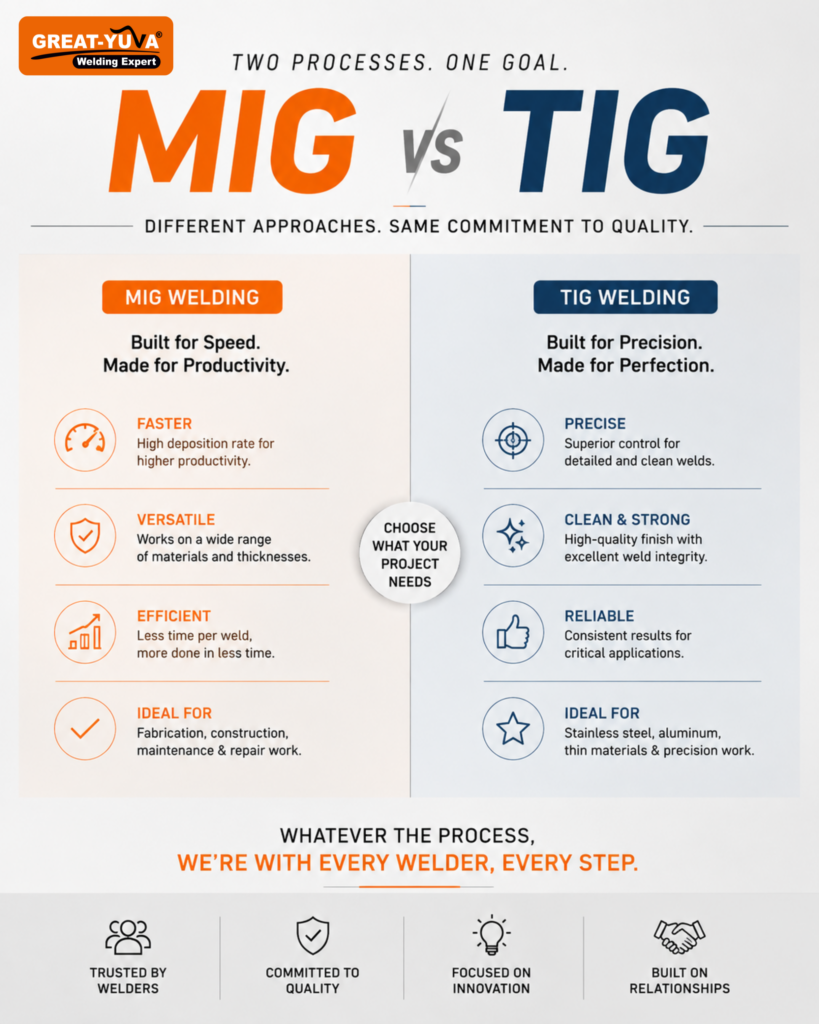
MIG vs TIG Welding: Understanding the Difference and Choosing the Right Welding Machine
21 July 2026
Welding plays an important role across industries where strong, reliable joints are required. Among the most commonly used welding processes, MIG and TIG welding are popular choices, but they differ significantly in their working methods, applications, speed, and level of control. Understanding these differences can help you choose the best welding machine for your specific requirements.
What Is MIG Welding?
MIG, or Metal Inert Gas welding, uses a continuously fed wire electrode to create the weld. The welding wire acts as both the electrode and, in many applications, the filler material. Shielding gas protects the weld pool from atmospheric contamination.
MIG welding is known for its high welding speed and ease of operation, making it suitable for production environments and applications involving longer welds. It can be used on materials such as mild steel, stainless steel, and aluminium.
For industries where productivity is a major priority, choosing the best welding machine with stable arc performance and suitable wire-feeding capabilities can make a significant difference in welding efficiency.
What Is TIG Welding?
TIG, or Tungsten Inert Gas welding, uses a non-consumable tungsten electrode to produce the arc. Unlike MIG welding, the filler material is generally supplied separately when required. An inert shielding gas, commonly argon, protects the welding area.
TIG welding provides excellent control and precision, making it ideal for applications where weld appearance and quality are especially important. It is commonly used for stainless steel, aluminium, thin sheets, pipes, and other applications requiring detailed welding.
While TIG welding generally requires more skill and takes longer than MIG welding, it offers greater control over heat input and the finished weld.
MIG vs TIG: Which One Should You Choose?
The right process depends on your application. MIG welding is generally preferred when speed, productivity, and ease of operation are important. TIG welding is better suited for applications requiring detailed control, clean welds, and high-quality finishes.
When selecting the best welding machine, consider factors such as the material you are welding, thickness, required welding speed, power supply, duty cycle, and the type of welding process you plan to use.
Choose the Right Welding Solution
There is no single machine that is the best welding machine for every application. The ideal choice depends on your specific welding requirements and working conditions. A reliable machine with stable performance, appropriate output, and suitable process capabilities can help improve productivity and welding quality.
With the right understanding of MIG and TIG welding, you can make a more informed decision and select equipment that matches your application—whether your priority is speed, versatility, control, or weld quality.